There is a version of the coffee farm visit that everyone has seen: a wooden sign at the gate, a tasting bar, a bag of beans at the till. It exists in Huila too, and there is nothing wrong with it. But most of the coffee grown here comes from somewhere else entirely — a family holding of two or three hectares on a slope steep enough to make your calves complain, where the person showing you around is the same person who will be picking until dusk.
Being welcomed into that second kind of place is a small privilege, and it comes with obligations that nobody will ever state out loud. Colombian hospitality is too polite to correct you. So here is the unwritten version, written down.
Huila has become one of Colombia's most important coffee departments — its coffee has carried a protected designation of origin, Café de Huila, since April 2013, recognised for a fruit-and-caramel sweetness, citric acidity and a round, clean body. That reputation was built by thousands of small growers, one steep hillside at a time.
What a finca actually is
Forget the word "plantation". The typical Colombian coffee farm is a family enterprise of a few hectares, worked by the household and, during harvest, by seasonal pickers paid by the kilo of cherry they bring in. The house, the drying area and the pulping machine are usually within a hundred metres of each other, which means that when you visit, you are not touring a facility. You are standing in someone's workplace and, quite literally, in their yard.
The land is steep, often between 1,200 and 1,900 metres, planted under a canopy of shade trees or in full sun depending on the grower's philosophy. Varieties tell you a lot: Caturra and Colombia are the workhorses, Castillo was widely adopted for its resistance after leaf rust devastated harvests around 2008 to 2012, and Huila has become known internationally for Pink Bourbon and other specialty lots that fetch a different kind of price.
The calendar that governs everything
Southern Colombia — Huila, Nariño, Cauca — runs on a different rhythm from the centre and north of the country.
- Main harvest: roughly March to June. The farm is at full stretch. Pickers are in the rows from first light, the pulping machine runs in the evening, and someone is checking the drying beds at ten at night.
- Secondary harvest: roughly October to December. Smaller, calmer, still busy.
- Between the two: pruning, fertilising, replanting, repairs. Quieter, and often the easiest time for a grower to give you two unhurried hours.
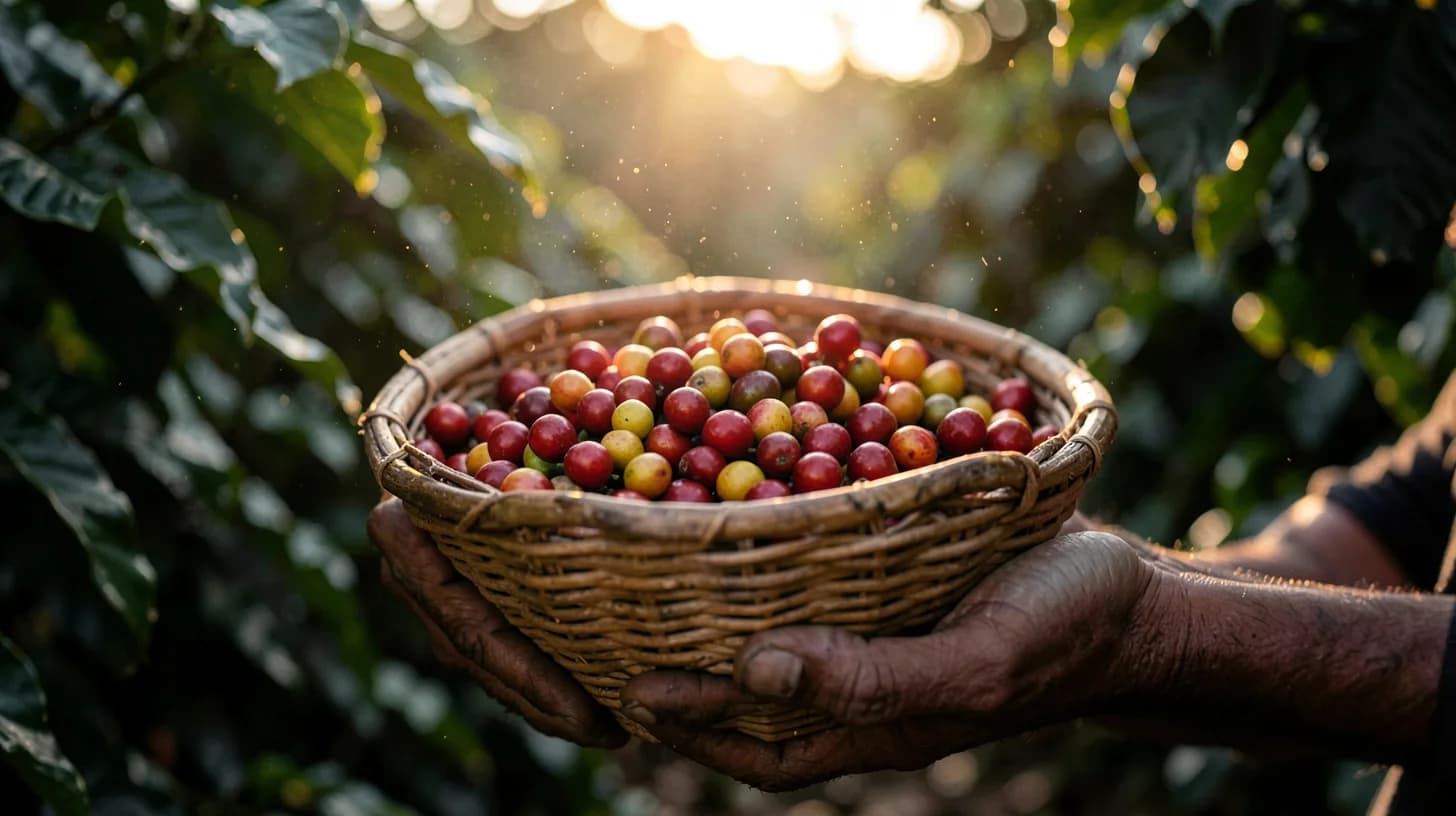
Visiting during harvest is more vivid. It is also the moment when your questions cost the household money. Both things are true; choose knowingly, and if you come in April, expect to be handed a basket rather than a brochure.
Twelve hours in the life of a cherry
Understanding the sequence is the best way to be a good guest: you stop standing in the wrong place.
- Picking. Only the ripe cherries, by hand, one at a time, several passes over the same tree across the season.
- Pulping, the same day. The outer fruit is stripped off and usually returns to the soil as compost.
- Fermentation, typically overnight in tanks, which loosens the sticky mucilage and shapes much of the cup you will eventually taste.
- Washing, then out to dry — on raised beds, patios, or under the clear-roofed structures growers call marquesinas.
- Drying, one to two weeks depending on sun and altitude, raked and turned by hand.
- Hulling and sale, in parchment, either to the cooperative or directly to a buyer.
The etiquette, plainly
- Arrange the visit in advance. Turning up unannounced at a working farm in harvest season is not adventurous, it is inconvenient.
- Pay for the visit. If a price is quoted, pay it without haggling. If no price is mentioned, ask what a tour is worth and pay generously — an hour of a grower's time in April has a real cost.
- Wear rubber boots or proper shoes. The slopes are slippery and the rows are muddy. Fashion sneakers announce that you did not think about the day.
- Never walk on the drying beds and do not run your hands through drying parchment. Body oils, sunscreen and dust all end up in the cup.
- Ask before photographing anyone. Landscapes are free; people are not. And ask before flying a drone, always.
- Skip the perfume. If there is any chance you will be cupping coffee, arrive scent-free. Cologne wrecks a tasting table for everyone.
- Accept what you are offered. A tinto, an aguapanela, a plate of food. Refusing is a bigger deal than you think it is.
- If you pick, follow instructions exactly — ripe only, no branch-stripping. You will be slow. Everyone was.
- Do not negotiate the price of what you buy. You are not in a market.
- Close every gate behind you and stay out of the pulping machinery.
Questions that open a door
Ask what altitude the farm sits at, which varieties are planted and why, how the last harvest compared to the one before, what the grower does with the pulp, whether they sell through the cooperative or direct, and what they themselves drink in the morning. These are questions about a craft, and they are almost always answered generously.
Avoid the two that land badly: telling a grower how coffee is done elsewhere, and asking how much they earn per kilo in a tone that suggests you already find it scandalous. If the economics come up, let them raise it. They usually will, and what they say will be more precise and more interesting than anything you had prepared.
The part that lasts
A morning on a working finca changes how you drink coffee for years. Not because the coffee tastes better on site — often it does not; the best lots are sold and shipped — but because you will never again be able to think of a cup as a commodity that appeared on a shelf. It has hands attached to it, and a hillside, and a week of someone watching the weather.
Phoenix Oasis will open on 30 June 2028 on 30 hectares near Rivera, in this same coffee country, and the region's growers were here long before the project and will be here long after it. The intention behind what is being built is to sit inside that local economy rather than beside it, which starts with something simple: treating a neighbour's farm as a workplace deserving respect, not as scenery.
More on the region in the Journal, and on the future stays on the retreats page.

 Colombia & Surroundings