The first Colombian breakfast usually surprises people. There is soup. Not a small bowl of something delicate — an actual bowl of hot broth, at seven in the morning, with meat in it.
This is not eccentricity. Colombia sits on the equator, which means the sun comes up at six almost every day of the year and the working day starts with it. In the Andean interior it is cool at dawn and hot by ten. Breakfast is built to carry a person from one to the other, and it is the meal where the food culture of the interior is most itself.
In Huila you get a particular version of it, shaped by heat, by corn, and by being the largest coffee-producing department in the country.
Broth, first
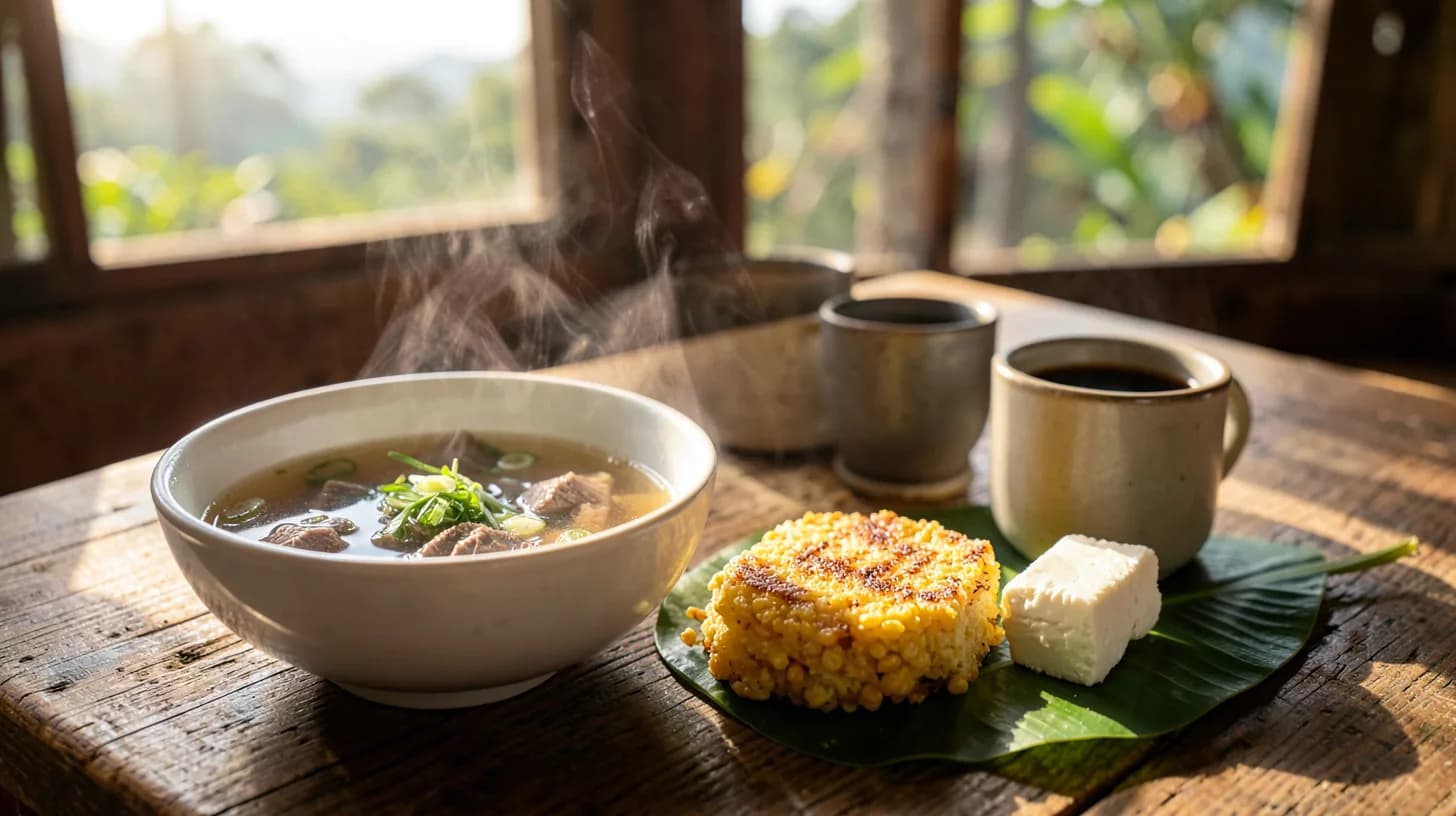
Caldo de costilla is the classic. Beef rib simmered with potato, spring onion and coriander, served clear with a wedge of lime and a bowl of rice on the side. It is savoury, hot, mildly salty and genuinely restorative — which is why Colombians call it a levantamuertos, a raiser of the dead, and eat it after long nights.
A little further north, in Bogotá and Boyacá, the equivalent is changua: a milk-based broth with a whole egg poached in it, spring onion, coriander, and stale bread dropped in to soften. It divides visitors sharply. Try it once; it is one of the last genuinely pre-Hispanic-influenced dishes still eaten daily in the highlands.
Corn, in several shapes
Corn is the backbone of breakfast across the interior, and it appears in more than one form.
- Arepa. A griddled corn cake, plain or made from fresh sweet corn (arepa de choclo), in which case it comes slightly sweet and is split around a slab of fresh cheese that melts inside it.
- Tamal. The weekend institution. In Huila and neighbouring Tolima the tamal is built on rice rather than corn dough, with pork, chicken, egg and vegetables, wrapped in plantain leaves and steamed for hours. It is eaten on Sunday mornings, with chocolate or coffee, and it is enormous.
- Envuelto de choclo. Sweet corn ground, wrapped in the husk and steamed. Eaten with cheese, always.
- Achiras. Huila's own contribution: small, crisp, savoury biscuits baked from sagú starch and cheese, made in and around the towns of the south of the department. They are sold in every bakery and bus station, and they exist specifically to be eaten with coffee.
The cheese question
Fresh cheese is not an accompaniment here. It is a structural element.
Quesillo is Huila's version — fresh white cheese, wrapped and pressed inside a plantain leaf and tied with fibre, sold as a parcel. It is mild, squeaky and slightly salty, and it is eaten with guava paste, with corn, or on its own.
And then there is the habit that visitors find hardest to accept: cheese in hot chocolate. A chunk of fresh cheese is dropped into the cup, left to soften, and eaten with a spoon at the end. It is standard across the Andean interior, it is not a joke, and it is very good. Suspend judgement until after the first spoonful.
What you drink
Tinto is the small black coffee that punctuates the entire Colombian day, often sweetened with panela. It comes in a tiny cup and it is bottomless in practice, because someone will always be offering another.
There is a piece of history in that cup. For most of the twentieth century, Colombia exported its best beans and drank the rejects — the low grade known as pasilla. Huila is now the country's largest coffee-producing department, its beans carry a protected designation of origin as Café del Huila, and its farms regularly place at the top of national quality competitions. One consequence of the specialty movement is that you can now drink genuinely excellent coffee here, on the farm where it grew, which was not true a generation ago.
Alongside it: aguapanela, hot water dissolved with unrefined cane sugar, drunk plain or with lime or with cheese in it. And juice, which will be offered en agua or en leche — with water or milk. Ask for cholupa if it is available. It is Huila's own passion fruit, it holds a protected designation of origin, and it is difficult to find anywhere else in Colombia.
Why it works
There is nothing accidental about this meal. Broth rehydrates and replaces salt before a hot day. Corn and rice give slow-release carbohydrate. Cheese and eggs supply protein. There is almost no refined sugar in it, and almost nothing sweet is eaten before mid-morning.
It is worth saying plainly that this is a description of a food culture, not nutritional advice — anyone with a specific dietary or medical question should take it to a professional. But as a piece of design, a Colombian breakfast is a sensible answer to a hot climate and an early start.
Mornings in Rivera
Phoenix Oasis will open on 30 June 2028 on thirty hectares in Rivera, Huila. The plan is for its mornings to begin early, in line with the light rather than against it, and for the food to be recognisably of this department rather than a hotel-buffet version of nowhere.
That means broth, corn, fresh cheese, local fruit and coffee grown within a few hours' drive — served at the hour when the valley is still cool and the day has not yet arrived.
Get up at six here and you will understand the whole culinary logic within a week. The heat explains everything.

 Colombia & Surroundings