Let us be honest at the start: Huila is not Cartagena. There are no ramparts here, no colonnaded courtyards painted in mango and indigo, no walled old town waiting to be photographed. The colonial architecture of this department is rural, modest and made of mud, and most travellers drive straight past it because it does not look like the postcard.
That is precisely why it rewards attention. What survives in the small towns of the upper Magdalena is not the architecture of viceroys but the architecture of a frontier — thick earth walls, deep eaves, whitewash, clay tile — built by people who had the ground beneath them and not much else. Once you can read it, you see it everywhere, including in buildings that are only fifty years old.
Here is how to read a Huila town.
Why they built in earth
Two reasons, and neither is romantic.
The first is availability. Stone quarrying and brick firing need capital and fuel; earth needs a wooden formwork, water and labour. This was never a wealthy colonial region — no silver, no viceregal court, just a long corridor between Popayán and the Magdalena River — and it built accordingly.
The second is physics. A rammed-earth wall half a metre thick or more has enormous thermal mass. In a valley where afternoons run past 30°C, that wall absorbs heat slowly all day and releases it at night, keeping interiors ten degrees cooler than the street. Deep overhanging eaves keep both the sun and the rain off the earth, which is the wall's only real enemy. Every feature you will notice has a job.
How to read a wall
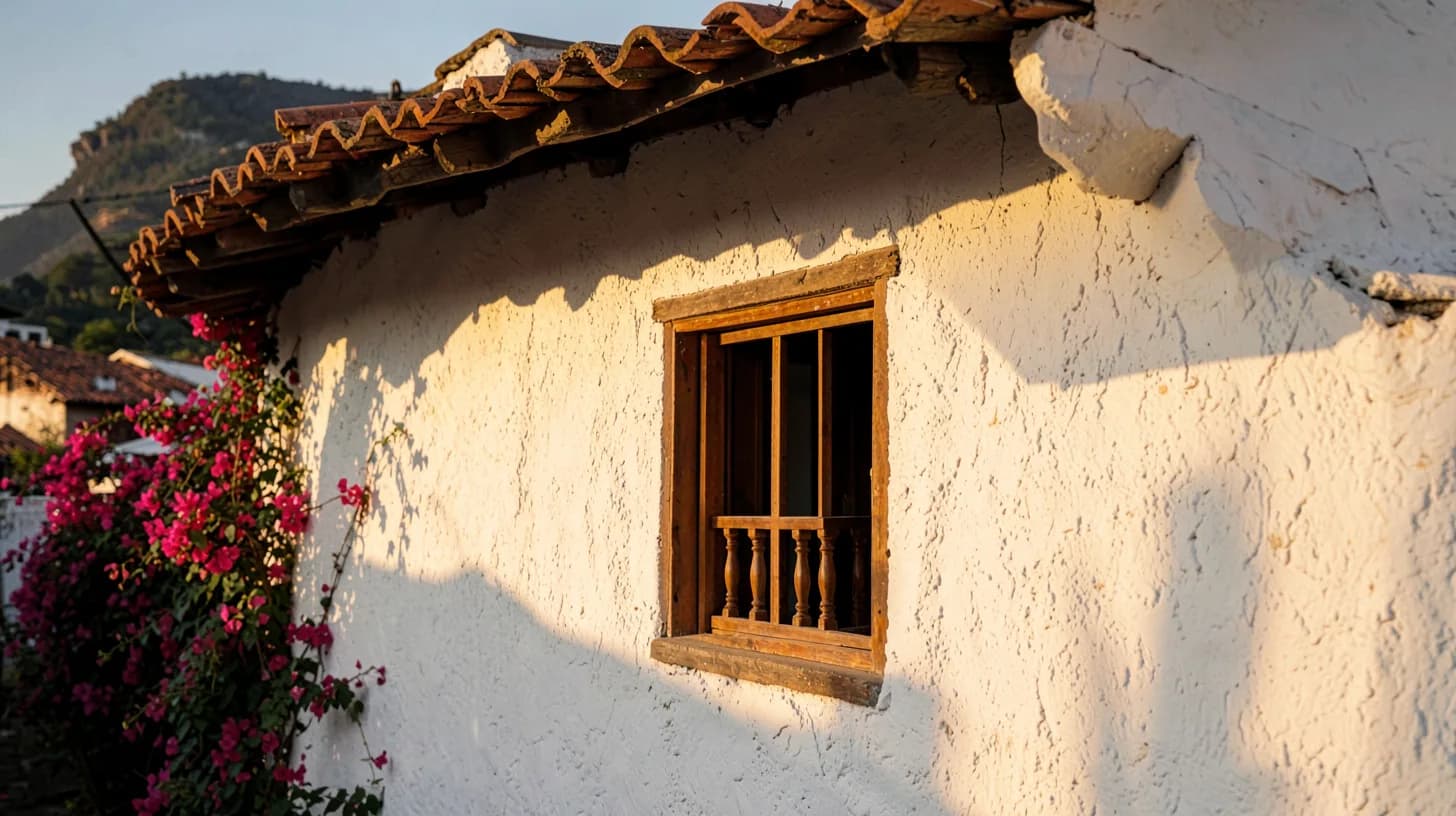
- Tapia pisada — rammed earth. Damp soil compacted in layers inside a wooden mould, one lift at a time. Look at a wall in raking evening light and you can often see the faint horizontal seams where each lift ended. Walls are thick; the giveaway is the depth of the window reveal, which will be as deep as your forearm.
- Bahareque — a frame of timber and cane packed and plastered with earth. Lighter, thinner, faster, and common for upper floors, partitions and rural chapels.
- The eave. A colonial or early-republican roof overhangs far beyond the wall, sometimes by a metre or more, supported on exposed rafters. That shadow line is the building's raincoat.
- The tiles. Hand-moulded clay tiles vary in curve, colour and length; twentieth-century machine tiles are uniform. A roof of mixed, mismatched tiles has been repaired across generations.
- The plan. A central patio with rooms opening onto a covered walkway; a zaguán, or wide entrance passage, from the street. The patio is not decoration, it is the ventilation system.
- The whitewash. Lime over earth render, reapplied every few years. It protects the surface and reflects heat.
Timaná: the oldest layer
Timaná was founded in 1538 by Pedro de Añasco, sent by Sebastián de Belalcázar to open a route between Popayán and the Magdalena. It is one of the earliest Spanish settlements in this part of Colombia, and its founding is inseparable from the story of La Gaitana, the cacica of the Yalcón people, whose son Añasco had burned alive and who then led a large indigenous rebellion against the conquistadors. In Huila she is not a legend but a reference point; her name is on schools, roads and monuments.
What remains architecturally is quiet and worth the detour: the Templo de San Calixto on the square, the Sanctuary of the Virgin of Miracles — a single-nave church of rammed earth with a wooden altar and pointed-arch side windows — and, above all, the residential streets, where houses of earth walls and clay tile roofs still stand in ordinary daily use.
Villavieja: the town that used to be Neiva
Neiva was founded three times. The first attempt came in 1539, the second in 1551 on the site now occupied by Villavieja, and both were destroyed in the long resistance of the Pijao. Neiva was finally established where it stands today in 1612, by Diego de Ospina y Medinilla. The abandoned second site kept a name that says everything: Villavieja, "the old town".
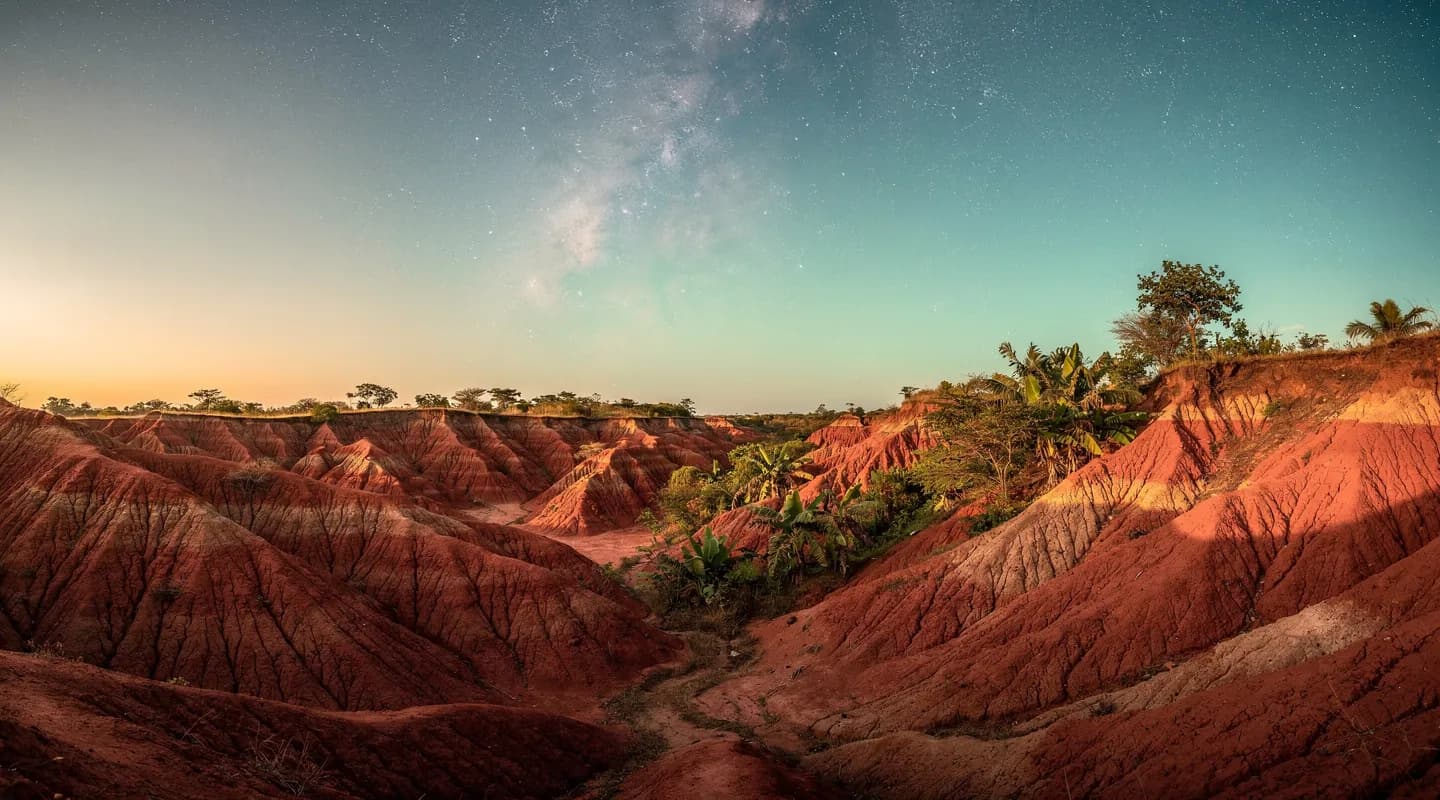
Its chapel of Santa Bárbara is one of the most important surviving religious buildings of the region — documented in the late eighteenth century as a bahareque structure with a thatched roof, and rebuilt in its present whitewashed form around the turn of the nineteenth century. It is small, plain and moving, and it sits a few steps from the museum that displays the fossils of the Tatacoa drylands beginning just outside town.
What is not colonial
A warning that will save you from a common error: many of the most photogenic churches in Huila are not colonial at all. The largest and most ornate — including several cathedral-scale buildings raised in the late nineteenth and early twentieth centuries — belong to the republican era, when new dioceses and new money built in brick, stone and imported styles. They are worth seeing. They are simply two or three hundred years younger than they look.
The genuinely old fabric in Huila is almost always the humble fabric: a chapel, a corner house, a wall.
The tradition, still standing
Earthen construction never fully stopped in this valley, and the logic behind it has not aged. Thick walls, deep shade, cross-ventilation, materials from within a few kilometres: this is what climate-appropriate building looks like when it has had four hundred years to be tested.
Phoenix Oasis will open on 30 June 2028 on 30 hectares near Rivera, and the accommodation planned for the estate is designed in wood, guadua and volcanic stone — a contemporary continuation of the same reasoning rather than a copy of it. Guadua, the giant Andean bamboo, has been holding up roofs in this region for a very long time.
For a future guest who wants to understand where those choices come from, the answer is not in a brochure. It is a couple of hours down the valley, in a whitewashed wall in Timaná, still doing its job.
More on the region in the Journal, and on the future stays on the retreats page.

 Colombia & Surroundings