The first thing you notice in a Huila market is not the crafts. It is the coffee, the fruit, the noise. The crafts are usually off to one side, on a folding table, being sold by the person who made them, at a price that will make you uncomfortable once you understand how long the work took.
Huila is not a famous craft department in the way Boyacá or Córdoba are. It has no single iconic object that tourists arrive already wanting. What it has instead is a set of quiet, functional traditions — palm, fibre, clay, thread — that were built around real use rather than around a souvenir market.
That makes them more interesting, and considerably more fragile.
The hat from Suaza
The best-known craft in the department comes from Suaza, a small town in southern Huila, where weavers work with iraca palm — Carludovica palmata, the same plant that produces the hats the world wrongly calls Panama hats, which are actually Ecuadorian.
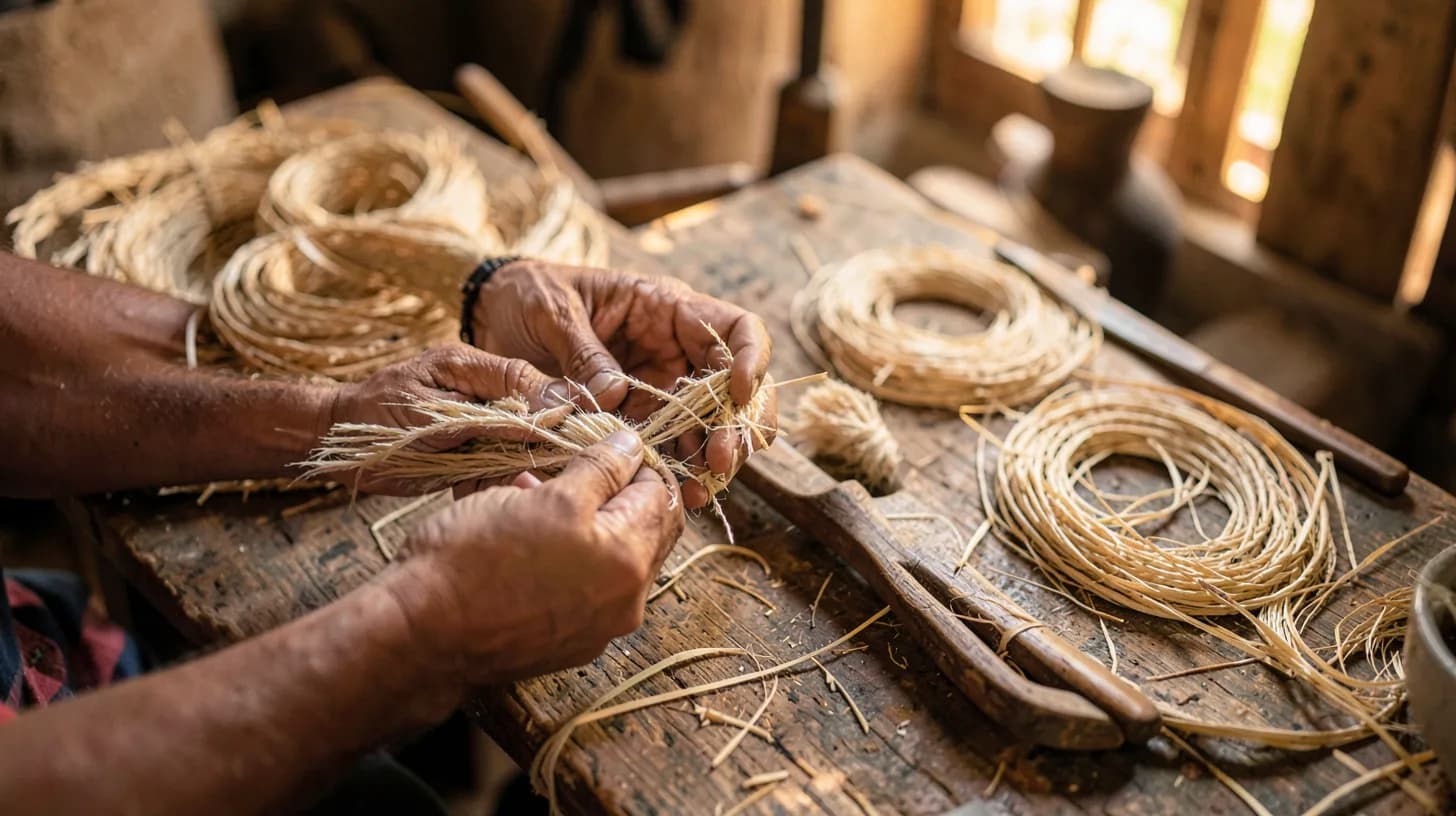
The process is long before any weaving starts. The unopened shoots of the palm are cut and split by hand into strands of the required fineness, boiled, dried and bleached in the sun. Only then does the weave begin, from the crown outward, in a spiral that has to stay perfectly even or the hat will never sit correctly.
A coarse hat takes a day or two. A fine one takes considerably longer, and the difference is visible when you hold the two side by side: the fineness of the straw, the tightness of the rows, the absence of any join you can find with a fingertip.
The Suaza hat is worn locally, not just sold. You will see it on farmers, on horsemen, and on dancers at the June festivals. That is an important sign of health in a craft — the moment an object exists only for visitors, it usually starts to get worse.
Fique, the plant that carries the coffee
Less visible, and economically much larger, is fique: a hard fibre taken from the sword-shaped leaves of Furcraea plants, related to agave.
Fique is stripped, washed, dried and spun into cabuya, the rough cord that has bound rural Colombia together for centuries. Its most important use is entirely unglamorous — the sacks that coffee travels in. Huila is Colombia's largest coffee-producing department, and its beans carry a protected designation of origin as Café del Huila, so the connection between fibre and the region's principal export is direct.
Artisans also weave fique into mats, bags, hammocks and rugs, dyed with both natural and industrial colours. It is scratchy, extremely durable and completely biodegradable, which has given it a second life among people looking to replace plastic.
Clay, not cloth: the chivas of Pitalito
The department's most recognisable handmade object is not woven at all. It is fired.
In Pitalito, in southern Huila, potters make the chiva — a small, brightly painted ceramic model of the wooden-bodied buses that still serve rural Colombia, loaded with passengers, chickens, luggage and improbable quantities of cargo on the roof. The tradition is associated above all with the ceramicist Cecilia Vargas, and it has since been carried on by workshops across the town.
They are cheerful, precise, and quietly documentary: a chiva figure records how people actually travel in the mountains, which is not how any tourist brochure shows it.
Who does this work
Two things are true about Colombian craft, and both matter here.
The first is that women make up the majority of the country's registered artisans. Weaving, embroidery and ceramics have historically been done at home, around childcare and farm work, which is exactly why they have been undervalued and under-recorded.
The second is that the economics are brutal. Craft is paid by object, not by hour. A weaver who spends three days on a hat and sells it for the price of a restaurant lunch is not being generous; she is competing with machine-made imports and with intermediaries who take most of the margin.
Colombia's national artisan body, Artesanías de Colombia, has worked since the 1960s on training, design and market access, and several Colombian crafts now hold protected designations of origin. But the fundamental problem is simple: the work is slow and the price is set by people who are not doing it.
How to buy well
If you want your purchase to be worth something to the person who made it:
- Buy from the maker where you can, at a workshop or a market stall, rather than from a shop in the airport.
- Do not haggle hard. Bargaining is normal in some contexts and corrosive here; the margins are already thin.
- Ask how long it took. Most artisans will tell you, and the answer usually reframes the price entirely.
- Buy one good thing instead of five cheap ones. The fine work is what disappears first when demand shifts to the cheap end.
- Ask what the material is. Iraca, fique, cotton, clay — knowing which is which is how you learn to see quality.
What this will mean in Rivera
Phoenix Oasis is under construction on thirty hectares in Rivera, Huila, and will open on 30 June 2028. The plan is for its material choices to come, as far as possible, from the department itself — fibre, wood, clay, cloth — and to be sourced from named workshops rather than from anonymous suppliers.
That is a commitment worth stating plainly, because it is easy to say and harder to do. A retreat centre buys textiles, baskets, tableware and furnishings by the hundred, and those orders are exactly the kind of steady, predictable demand that lets a craft workshop plan a year instead of a week.
Bring a hat home. Ask who wove it. That is a small act, and it is not nothing.

 Colombia & Surroundings