Every country has a river it cannot do without. Egypt has the Nile, the United States has the Mississippi, and Colombia has the Magdalena — except that Colombians rarely put it that grandly. They call it el río, or sometimes, in the old formal register, el Río Grande de la Magdalena, and they treat it less as a landmark than as a relative.
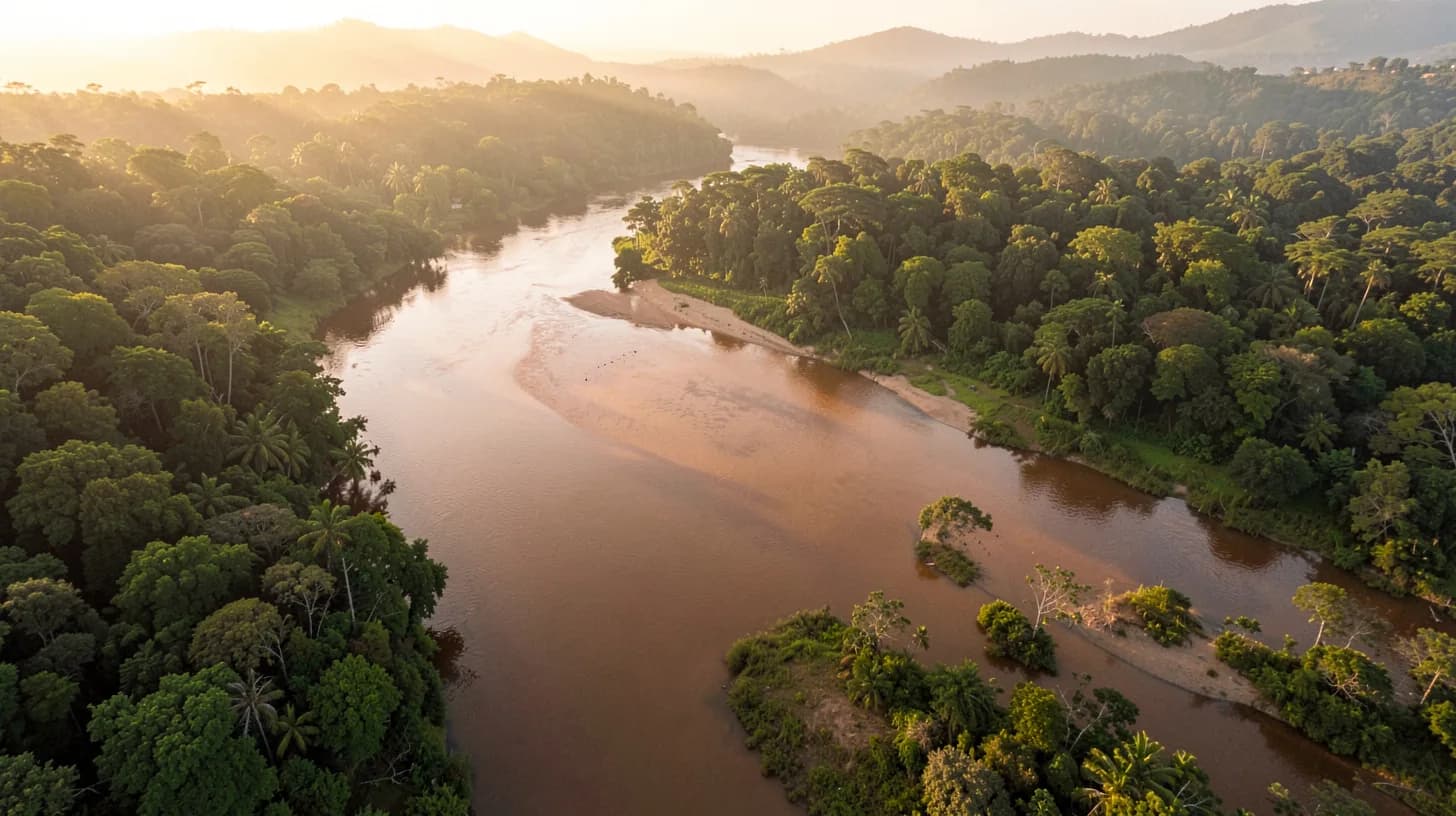
It runs 1,528 kilometres from the high Andes to the Caribbean, straight up the country's middle, in the trench between the Central and Eastern cordilleras. Its basin covers roughly a quarter of Colombia's land area and holds the large majority of its people and its economy. Bogotá, Medellín, Barranquilla, Neiva, Honda, Mompox — the whole national story is arranged along it.
And it starts in Huila.
A lagoon at 3,685 metres
The recognised source is the Laguna de la Magdalena, a small páramo lake in the Páramo de las Papas, high in the Colombian Massif inside the municipality of San Agustín, at roughly 3,685 metres above sea level.
The páramo is a strange, specific ecosystem — a high, cold, permanently damp grassland found only in the northern Andes, populated by frailejones, the woolly, slow-growing plants that trap mist and release it into the soil. Páramos are water factories. The Colombian Massif alone gives rise not just to the Magdalena but to the Cauca, the Caquetá and the Patía, which is why Colombians sometimes call it the country's water star.
Reaching the lagoon takes effort: horses, a guide, cold rain, altitude. What you find at the end is unimpressive by design — a dark pool in a bowl of grass. That is the whole point. The river that carries the country begins as something you could walk around in ten minutes.
Two point two metres wide
Not far downstream, near San Agustín, the young Magdalena does something extraordinary. At the place called El Estrecho, the entire river is forced through a gap in the rock roughly two metres across — commonly cited at about 2.2 metres. You can stand at the edge and watch the whole of Colombia's central artery pass beneath you in a single dark rope of water.
Downstream of that, it broadens for good, gathering the Suaza, the Páez, the Yaguará, and later the Cauca, until by the middle valley it is a kilometre-wide plain of moving sediment.
When the river was the only road
For four centuries the Magdalena was Colombia's principal highway, and travelling inland meant travelling upstream. Cargo and passengers were poled and paddled up from the coast in champanes by crews who worked the current for weeks.
Steam changed the tempo. From the 1820s, steamboats began working the lower and middle river, and by the late nineteenth century the Magdalena carried nearly everything: coffee going out, machinery coming in, students, soldiers, bishops, coffins. Honda, where rapids interrupt navigation, became a transfer town of warehouses and mule trains. Mompox, on a quiet arm of the river, grew rich on that traffic — and then the main channel shifted to another branch and the town simply stopped, which is why its colonial centre survives so completely that UNESCO inscribed it as a World Heritage Site in 1995.
The steamboats died in the mid-twentieth century, killed by railways and then roads. Navigation on the Magdalena has never recovered its old importance, and restoring it remains a live and contested national debate.
What lives in it, and what is leaving
The river is an ecosystem under real pressure, and the honest list is sobering:
- The bagre rayado (Pseudoplatystoma magdaleniatum), its great striped catfish, is assessed as critically endangered.
- The Magdalena river turtle (Podocnemis lewyana), found nowhere else, is also critically endangered.
- The Antillean manatee survives in scattered pockets of the lower basin.
- The bocachico, the migratory fish that fed the whole valley, returns in a fraction of its former numbers.
The causes stack: deforestation in the headwaters, one of the heaviest sediment loads of any river on earth, drained wetlands, dams, mercury from informal gold mining, and untreated urban discharge. Cormagdalena, the public corporation created to manage the river, exists precisely because the problem is national rather than local.
The river that Colombia wrote
No river in Latin America has been written about more affectionately. Gabriel García Márquez travelled it repeatedly by steamboat as a student, and the journeys never left him: Love in the Time of Cholera ends on a riverboat going nowhere on purpose, and The General in His Labyrinth follows Simón Bolívar's real last descent of the Magdalena in 1830, ill and discarded, towards the coast where he died.
Read either one before you travel here and the water will look different. The Magdalena in Colombian literature is never scenery. It is time itself — patient, indifferent, and carrying everything downstream whether or not anyone is ready.
Standing near the beginning
Phoenix Oasis is being built on thirty hectares in Rivera, Huila, and will open on 30 June 2028. It sits in the upper valley, in the department where the river is born — closer to the Magdalena's source than to almost anything else in its long life.
That is not a marketing coincidence; it is simply geography, and it is worth knowing. When the centre opens, guests will be a short drive from the river at a point where it is still young, still fast, still recognisably a mountain stream that has decided to become something enormous.
It is a useful thing to stand next to. Rivers do not arrive anywhere quickly, and they do not go back.

 Colombia & Surroundings