 Foundation
Why the Social Work Is a Foundation, Not a CSR Department
A separate legal entity is slower, costlier and harder to control. That is the argument for it — and the reasons a foundation can fail just as easily.
5 min read

Foundation
Phoenix Initiative4 min read
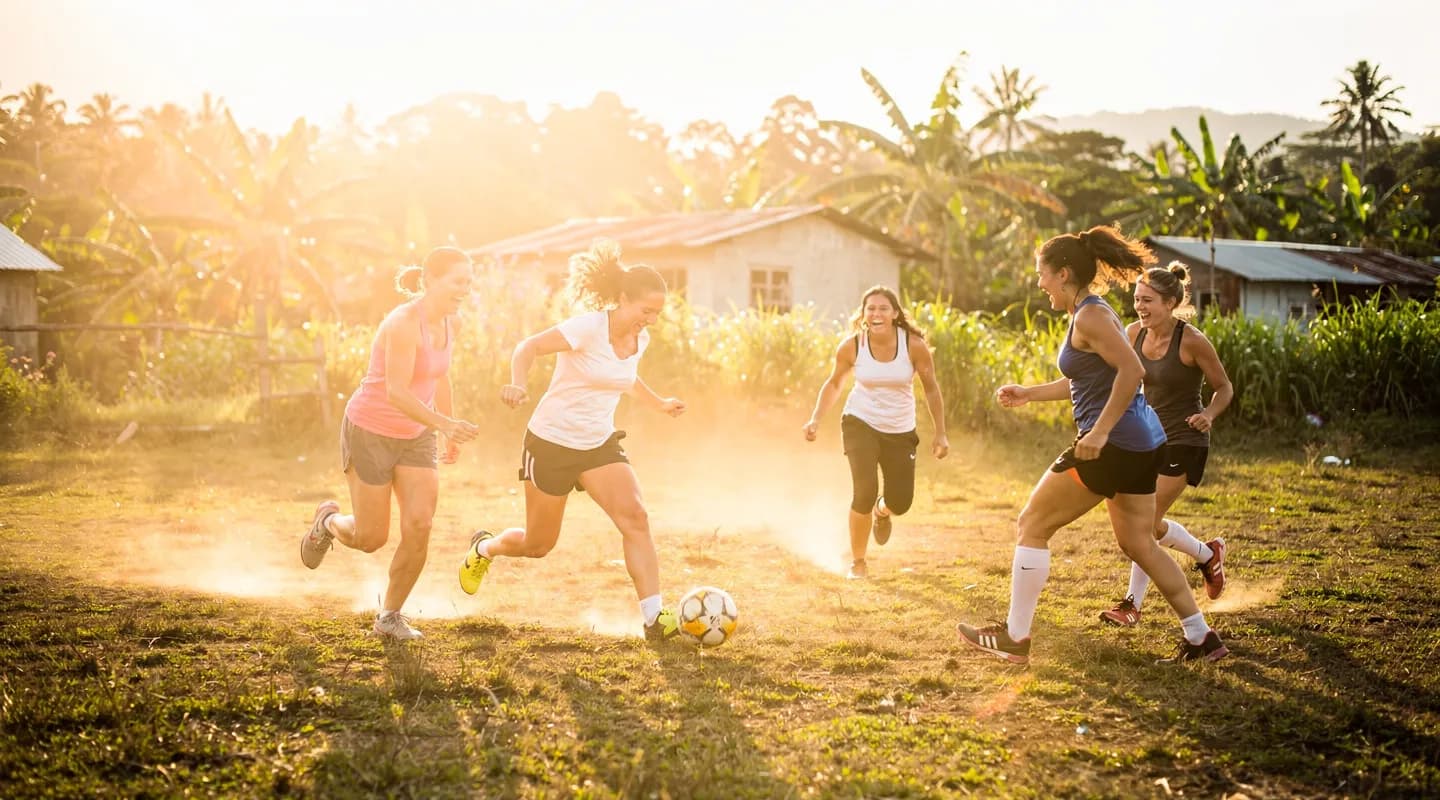
Picture a dusty pitch at the edge of a village, an hour before sunset. A handful of girls warming up, a coach counting reps, a few neighbors drifting over to watch. Nothing about the scene looks like social policy. And yet decades of experience from community programs around the world point to the same quiet truth: few things change a place as reliably as people moving together, on purpose, week after week. Sport for social impact is one of the three pillars of Phoenix Initiative Colombia, the foundation rooted in Rivera, Huila — and here is why that bet makes so much sense.
When a community invests in sport, it is not just buying equipment and marking out a field. It is sending signals. To girls: your body is for strength and play, not only for work or judgment. To teenagers: there is a structured place for your energy. To adults: showing up matters more than being talented. To everyone: this village believes it has a future worth training for.
Those signals compound. A training session is a commitment kept in public, and every kept commitment makes the next one easier — for a person and for a community. If you have ever joined a running group or a gym class, you know the feeling: you came for the workout and stayed for the people.
Research on youth and community sport has long pointed in one direction: regular physical activity can help build self-esteem, resilience and social confidence, and organized sport is associated with stronger school engagement and leadership skills — especially for girls, who in many rural areas have fewer organized opportunities than boys.
None of this works like a switch; it works like training. Confidence built through movement is earned in small increments — one more rep, one first goal, one race finished — which makes it unusually durable. Nobody can argue you out of something your own body proved to you. That is why movement programs so often become the front door to everything else: a girl who discovers she can lead a warm-up finds it easier to raise her hand in a classroom, and later, in a meeting.
In rural communities, distance is the silent tax on opportunity: the library, the club, the course are always somewhere else. A local, recurring, well-run sports program is powerful partly because of what surrounds the sport itself — a predictable time, a safe place, a trusted adult, a peer group with a shared goal.
For women and girls, that safety and regularity matter twice as much. A women's training group is often one of the few spaces that belongs entirely to them — no gatekeepers, no justification needed. Protect that space, keep it consistent, and it quietly becomes infrastructure: as real as a road, and sometimes more transformative.
Phoenix runs on a simple piece of arithmetic called the 1% philosophy: get 1% better every day, and after a year you are almost 38 times further along — 1.01 to the power of 365 is roughly 37.8. Applied to one woman, it is a training plan. Applied to a community, it becomes something bigger.
One weekly session does not transform a village, any more than one workout transforms a body. But sessions become habits, habits become groups, groups produce coaches, coaches start new groups. Sport for social impact is compounding in its purest form: the returns are invisible for a while, and then suddenly they are everywhere — in posture, in friendships, in who speaks up at the community meeting.
There is also a practical, economic thread. Sport creates roles: coaches, referees, organizers, first-aiders, people who can run an event or manage a schedule. These are real, transferable skills, and community programs are one of the few places rural young people can practice them early and often.
This is where sport connects to the foundation's other pillars — education and training, and land regeneration. A movement program can be a first taste of leadership that leads to a vocational course. An outdoor training culture builds people who know and care for their landscape. The pillars feed each other by design, because that is how lasting change actually happens: from several directions at once.
Movement is also the beating heart of what Phoenix Oasis is being built to offer — a place in Huila where women will train, hike, box and recover among waterfalls, with programs designed around strength and transformation. The center opens on June 30, 2028, and the same conviction runs through both the foundation and the retreat: a stronger woman strengthens everything around her. If you are curious what that will look like in practice, take a look at the planned stays — explore the programs.
FoundationA separate legal entity is slower, costlier and harder to control. That is the argument for it — and the reasons a foundation can fail just as easily.
5 min read
 Foundation
Most programmes lose single mothers at the timetable, not at the door. The Foundation intends to design around care work from the first sketch.
5 min read
 Foundation
Not a tournament, not a launch event. A design for recurring open days in Rivera — and an honest list of the ways this kind of thing usually fails.
5 min read