The first time you run at altitude, the experience is oddly humiliating. Your legs feel fine. Your training is intact. And yet at a pace you could hold for an hour at home, you are breathing like someone in the final kilometre of a race. Nothing is wrong with you. There is simply less oxygen arriving per breath, and your body is doing arithmetic it did not have to do before.
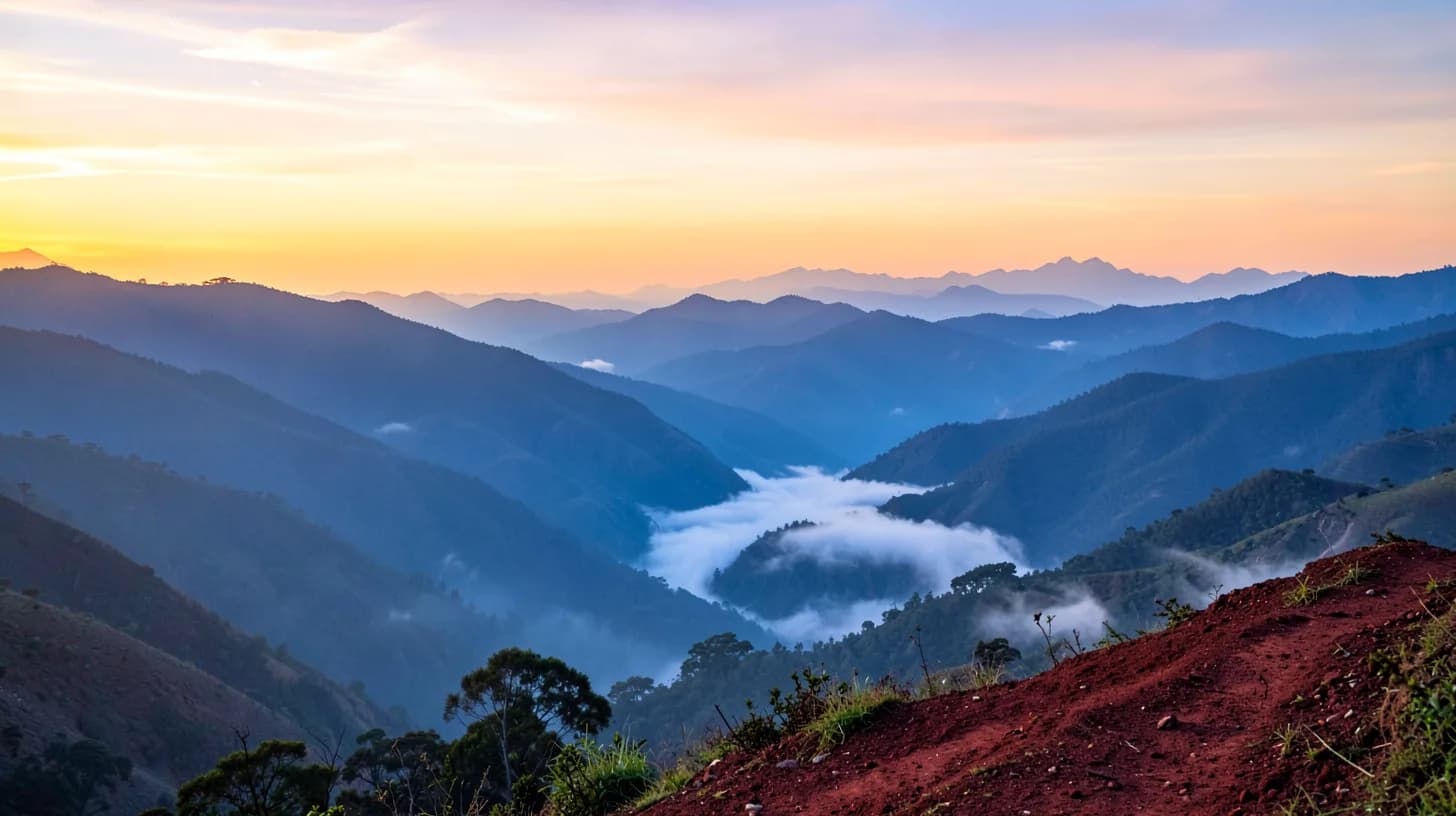
Colombia makes this vivid. In a single day you can move from the Magdalena valley floor at a few hundred metres to páramo grasslands above 3,000, and the department of Huila alone stretches from warm lowland river country to the Nevado del Huila volcano at 5,364 metres. The country's cycling tradition is built on that vertical geography: riders raised in the high towns of Boyacá and Cundinamarca grow up training in air that most of the world only visits.
Understanding what altitude does — and where it starts mattering — turns an unpleasant surprise into a manageable variable.
What thin air actually does
A common misconception is that there is less oxygen in mountain air. There is not: the atmosphere remains about 21 per cent oxygen at any altitude a human can survive. What falls is barometric pressure, and with it the partial pressure of oxygen — the force pushing oxygen across the membranes of your lungs into your blood.
The consequences cascade quickly:
- Arterial oxygen saturation drops. Less oxygen bound to haemoglobin means less delivered to working muscle.
- Ventilation rises. You breathe faster and deeper at any given effort, which is why easy running feels urgent.
- Heart rate climbs at submaximal work, while maximum heart rate tends to fall slightly.
- Maximal aerobic capacity falls. Above roughly 1,500 metres, VO2 max declines on the order of 1 to 2 per cent for every additional 100 metres.
- You lose more water. Dry mountain air plus heavier breathing means substantial respiratory fluid loss, on top of sweat.
Where altitude begins to matter
Not all elevation is created equal, and the thresholds are worth knowing.
- Below about 1,200 metres — negligible effect on endurance for most people.
- 1,200 to 2,000 metres — measurable but modest. Endurance performance starts to decline; hard intervals feel disproportionately harder.
- 2,000 to 3,000 metres — the classic "moderate altitude" band where most training camps sit. Effects are unmistakable, and acclimatization becomes essential.
- Above 2,500 metres — the range where altitude illness becomes a genuine consideration. Headache, nausea, poor sleep and breathlessness at rest are not badges of toughness; they are symptoms that need a doctor's assessment, not a harder session.
Bogotá sits at about 2,640 metres, which is why visiting athletes routinely have a rough first week there.
The first days: what to change
The body begins adjusting almost immediately, but the useful adaptations arrive on different timelines. Ventilation and heart rate shift within hours to days. The hormonal signal to make more red blood cells begins within a day, but a meaningful increase in red cell mass takes three to four weeks.
For a stay of a week or two, the practical protocol is modest and effective:
- Take the first two or three days easy. Cut intensity substantially, keep sessions short, and expect to feel worse than the numbers suggest you should.
- Train by perceived effort, never by pace. Your usual splits are simply not available yet, and chasing them is the fastest route to a wrecked week.
- Drink more than feels necessary, and salt your food. Respiratory losses are invisible and easy to underestimate.
- Protect sleep. The first two or three nights at altitude are often broken, with periodic breathing patterns that feel alarming and are usually normal.
- Reintroduce intensity gradually, starting with short efforts and long recoveries rather than sustained threshold work.
What slows down, and what does not
Altitude is not uniformly unkind. Events lasting more than about two minutes suffer, because they depend on oxygen delivery. Very short, powerful efforts — a sprint, a heavy set, a jump — are barely affected, and pure sprinting can even be marginally faster in thinner air because there is less aerodynamic drag.
Practically, this means a training week at moderate altitude should lean toward strength, technique, mobility and short powerful work, with endurance kept honest but unambitious for the first stretch. The mountains reward patience and punish stubbornness with remarkable consistency.
One more thing worth knowing: the body's response to altitude depends on having enough iron available to build red blood cells. Women, who have higher iron requirements across the reproductive years, are more likely to arrive with low stores. This is a subject for a blood test and a qualified professional before a trip, not for self-prescribed supplements.
Between the valley and the ridge
The land around Rivera, in Huila, offers exactly the gradient that makes this interesting: a warm river valley where the air is thick and the heat does the work, with the Eastern Cordillera rising steeply behind it into cooler, thinner air within a short drive.
That vertical range is one of the reasons the 30 hectares of Phoenix Oasis are being developed there. The plan is for endurance work to use the whole gradient — long easy days low, short sharp days high — rather than treating altitude as an obstacle. When the site opens on 30 June 2028, the mountains will not be scenery behind the training; they will be part of it.
Until then, if you are heading anywhere above two thousand metres, go slowly for three days. The mountain is not going anywhere. You can see how the stays are being designed in the meantime.

 Training