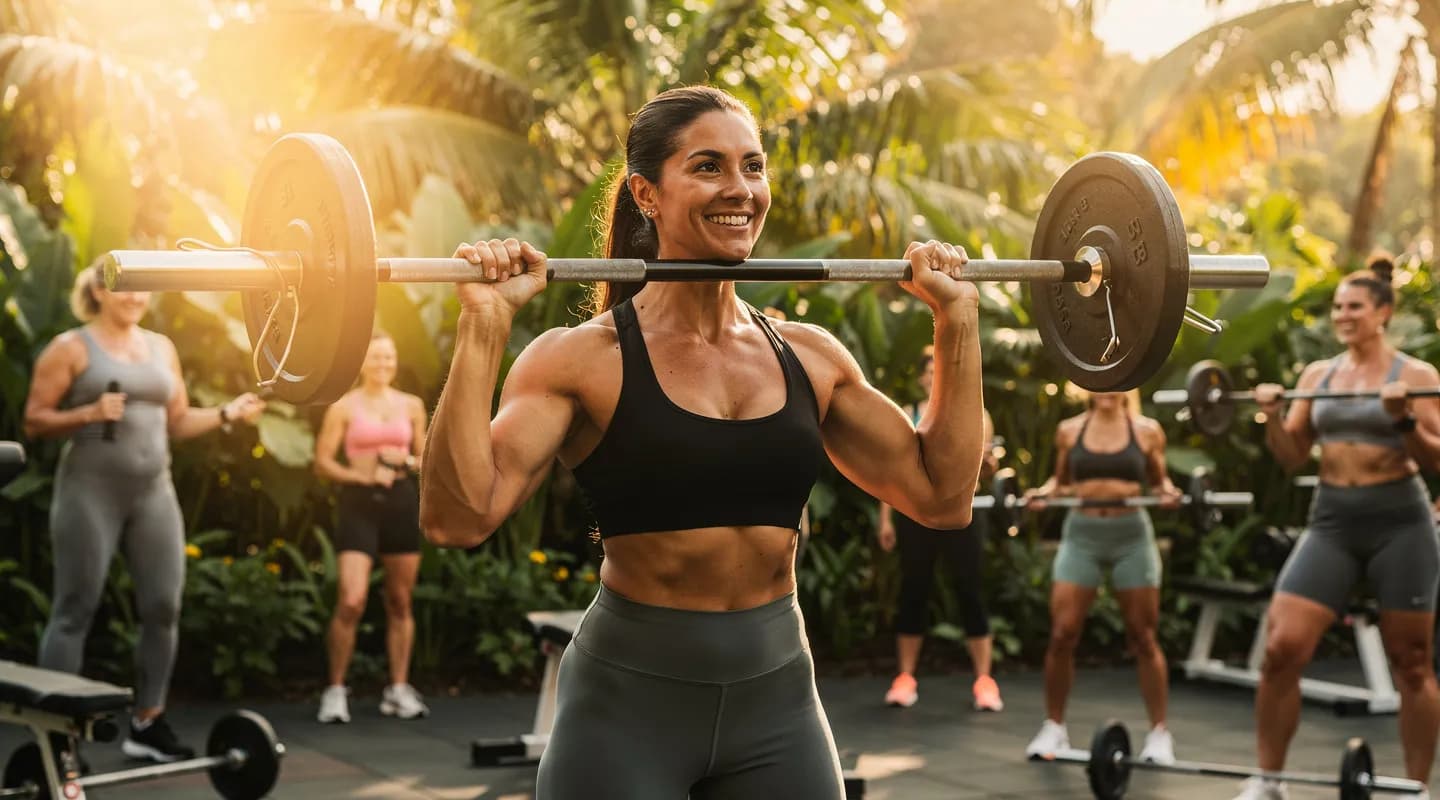
The best training plan is the one that survives your actual life. Not the one that works in a well-equipped gym, ten minutes from home, on a week when nothing goes wrong — the one that still works in a hotel room in a city you did not choose, on a Tuesday when the flight was delayed and the only floor space is between the bed and the window.
That is the quiet argument for bodyweight training. It is not a compromise or a beginner's version of "real" strength work. It is a complete system of its own, built on the fact that a human body is already a load, already a lever, and already capable of an enormous range of resistance depending on how you arrange it in space.
What follows is a foundation: the movement patterns worth owning, the four dials you can turn to make them harder, and a short session you can run anywhere. No equipment, no subscription, no excuses left standing.
The six patterns that cover a whole body
Strength training is easier to think about as patterns rather than exercises. Almost everything a body does in daily life falls into six categories, and a programme that covers all six leaves very few gaps.
- Push — pressing something away from you. Push-ups in all their variations, from hands-elevated on a table to feet-elevated on a chair.
- Pull — bringing something toward you. The hardest pattern to train without equipment: use a sturdy table edge for inverted rows, a towel looped around a solid post, or a doorway frame.
- Squat — bending at the knees and hips together. Bodyweight squats, split squats, step-ups onto any stable surface.
- Hinge — bending mostly at the hips with a long spine. Single-leg deadlifts, glute bridges, hip thrusts with shoulders on a bed edge.
- Carry and brace — resisting movement rather than creating it. Planks, side planks, dead bugs, farmer-style walks with luggage.
- Locomotion — walking, running, crawling, climbing stairs. The pattern most people already have access to and most consistently underuse.
Cover those six across a week and you have trained the whole body, honestly and without gaps.
Four dials that make bodyweight hard
The standard objection is that bodyweight training cannot progress: your body weighs what it weighs. That is true and completely beside the point. Load is only one variable among several, and the others are generous.
- Leverage. Change the angle and you change the resistance dramatically. A push-up with hands on a kitchen counter might be 40 per cent of your bodyweight through the arms; the same movement with feet on a chair pushes past 70 per cent. Same exercise, entirely different demand.
- Tempo. Lower for four slow seconds instead of one. Time under tension rises, momentum disappears, and a movement you thought was easy becomes a conversation with your own muscles.
- Range of motion. Deeper squats, push-ups with the chest passing below the hands, split squats with the back foot elevated. More range means more work, and usually more mobility as a side effect.
- Unilateral work. One leg, one arm. A single-leg squat is not half a squat — it is a different exercise entirely, with a balance and hip-stability tax that no machine replicates.
Turn those four dials and a floor becomes a fully adjustable gym.
A twenty-minute session that needs only the floor
Run this as a circuit: three rounds, moving from one movement to the next with minimal rest, then two minutes of rest between rounds. Adjust the numbers to your current level rather than to your ego.
- Squats — 12 to 20 reps, slow on the way down.
- Push-ups — 6 to 15 reps, hands elevated on a bed or table if needed.
- Split squats — 8 to 12 per leg.
- Inverted rows under a sturdy table, or a towel row around a solid post — 8 to 12 reps.
- Glute bridges — 15 to 20 reps, pausing for two seconds at the top.
- Plank — 30 to 60 seconds, ribs down and glutes engaged.
The whole thing takes about twenty minutes. Done three times a week with the dials gradually turning, it will build genuine strength for a very long time before it stops working.
Progression without a single plate
Progressive overload simply means asking for slightly more than last time. Without weights, the ladder looks like this: add a rep, then another, until the top of your range feels controlled. Then slow the tempo. Then change the leverage — feet a little higher, hands a little lower. Then take a limb away.
Write it down. A two-line note after each session, recording what you did and how it felt, is worth more than any app. Progress in bodyweight training is genuinely invisible unless you keep a record, because nothing on the outside changes: the room is the same, the floor is the same, only you are different.
Where bodyweight training reaches its limits
Honesty matters more than enthusiasm. Bodyweight work builds strength, control and endurance beautifully, and the pulling patterns and lower body will eventually outgrow what a floor can offer. Heavy external loading also stimulates bone in ways that lighter work does not, which matters particularly for women thinking in decades rather than seasons.
The sensible view is that bodyweight training is the foundation, not the ceiling. It is what you do first, what you return to when life scatters your routine, and what makes barbells and hills far more useful when you get to them. If you have a health condition, a recent injury or a pregnancy in the picture, talk to a qualified professional before starting anything new — that is a conversation, not a formality.
A foundation you will bring with you
Everything above needs nothing but a floor and a decision, which is exactly why it belongs at the start. At Phoenix Oasis in Rivera, Huila, the 30 hectares under development will eventually offer far more than a floor — open-air platforms, mountain trails, water. But the women who arrive from July 2028 with these six patterns already in their bodies will be the ones who get the most from it, because the terrain will be adding to something real rather than starting it from scratch.
Start now, where you are, with what you have. That habit will travel further than any equipment. You can see how the stays are being designed while you build it.

 Training