A woman who runs comfortably for an hour at home can find herself walking, dripping and slightly humiliated forty minutes into a tropical trail. Her fitness has not vanished. It has simply met three conditions it was never trained against: air that will not accept her sweat, ground that refuses to be predictable, and a gradient that changes every fifty metres.
The good news is that all three are trainable, and two of them adapt faster than most people expect. The bad news is that the usual assumption about which one is hardest tends to be wrong.
What the terrain is actually asking
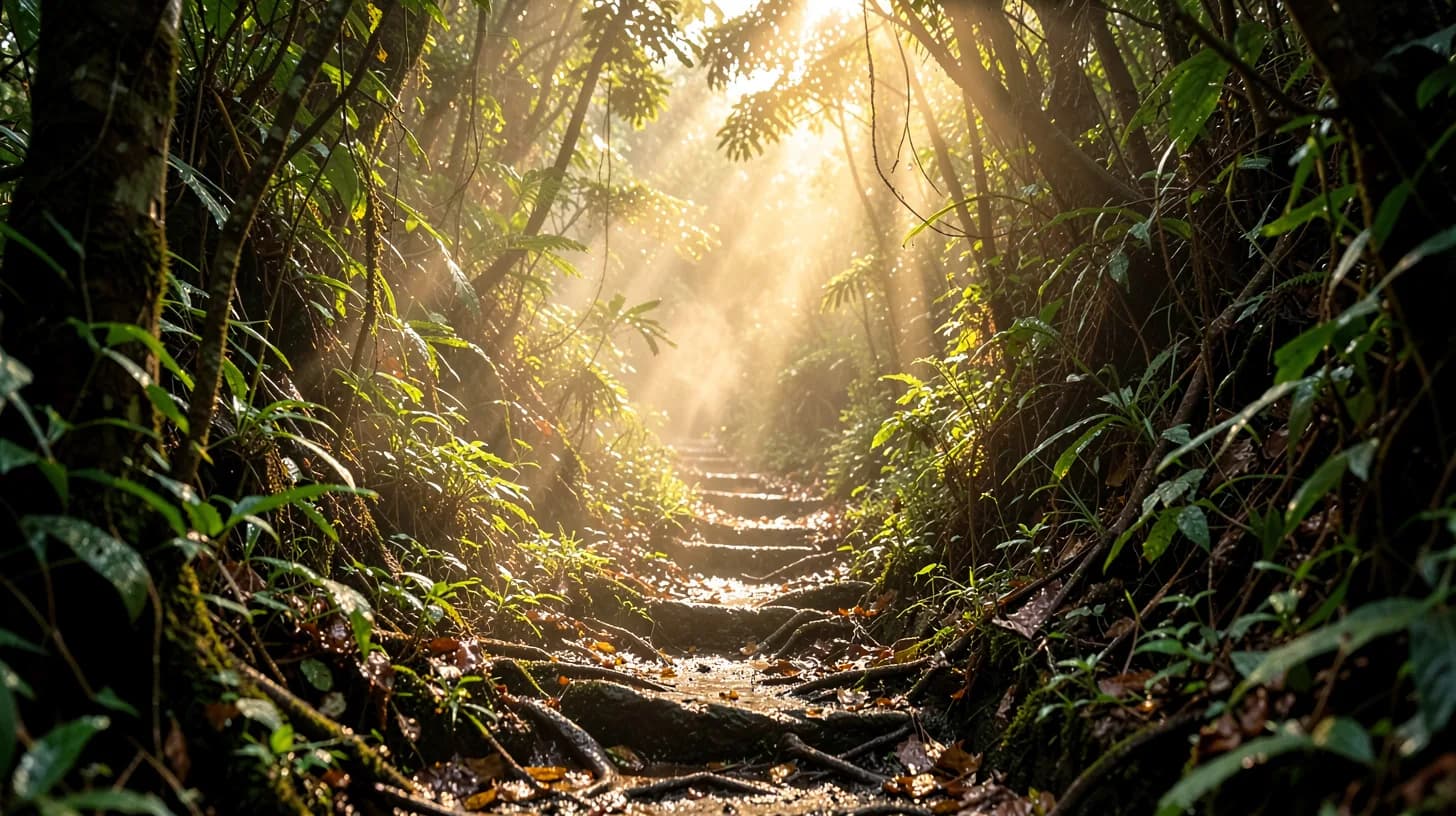
Flat ground is a rhythm. A jungle trail is a series of decisions — a root, a wet stone, a step that is higher than the last, a descent that turns to mud.
Physically, this means constant work from the intrinsic muscles of the foot, the ankle stabilisers and the hip abductors, none of which do much on a treadmill. It means the quadriceps working eccentrically on every descent, lengthening under load rather than shortening, which is the mechanism behind most trail-induced soreness. And it means a cardiovascular cost that swings wildly rather than sitting in a steady zone.
The efficient trail walker adapts by shortening her stride, raising her cadence, keeping her eyes four or five metres ahead rather than at her feet, and accepting that pace per kilometre is a meaningless number on this kind of ground. Time on feet and perceived effort replace it.
Humidity is the real limiter
Here is the mechanism that explains almost everything about tropical effort: you do not cool down by sweating. You cool down by evaporating sweat. When the air is already close to saturated with water vapour, evaporation slows dramatically, and sweat that rolls off your skin and lands on the ground has removed almost no heat from you.
So in high humidity your body sweats more and cools less. Core temperature climbs, heart rate drifts upward at the same effort, plasma volume falls, and perceived effort rises steeply. This is not weakness; it is thermodynamics.
Heat acclimatisation is genuine and reasonably quick. Over roughly one to two weeks of regular exposure, the body expands plasma volume, begins sweating earlier and more freely, and conserves sodium by producing more dilute sweat. Most of the adaptation appears in the first week. Practically, this means the third day of a tropical week is often the hardest, and the eighth feels like a different body.
The practical implications: train early or late in the day, drink to thirst and include sodium in long or heavy sessions, wear light and genuinely loose clothing rather than technical fabric that clings, and treat the first days somewhere hot as adaptation rather than as a test. Anyone with a cardiovascular condition, or who is pregnant, or on medication that affects heat regulation, should get advice from a health professional before training hard in this kind of climate.
Altitude, honestly
Altitude is the glamorous concern and usually the wrong one. Meaningful physiological effects on endurance generally begin somewhere above roughly 1,500 metres and become serious much higher.
Huila is a department of extremes. It runs from the valley of the upper Magdalena — Colombia's principal river, which rises in the south of the department — up to the páramos and the summit of Nevado del Huila, at around 5,364 metres the highest volcano in the country. But Rivera, in the valley near Neiva, sits at modest elevation, and the trails around it are not high-altitude terrain.
The honest summary: at that kind of elevation, heat and humidity will limit you long before oxygen does. Save the altitude planning for the páramo, and train for the climate.
Training for it before you arrive
You cannot import a jungle, but you can build most of what it demands.
- Uneven ground. Any of it. Forest paths, beaches, rough parkland. Ankles adapt to variability by being exposed to variability.
- Eccentric descent work. Downhill walking, step-downs, slow tempo split squats. Descending is where trails hurt, and it is the most neglected preparation.
- Loaded hill repeats. Uphill walking with a pack builds the exact combination of aerobic and muscular endurance that climbing demands.
- Foot and calf strength. Calf raises through full range, barefoot work on safe surfaces, toe and arch strength. Small muscles, large consequences.
- Heat exposure, if it is safe for you. Training in warmer conditions or finishing sessions with sauna or hot bathing can begin some of the adaptation before travelling. This one warrants caution and a sensible progression.
Long, slow, boring aerobic volume underpins all of it. Trail capacity is built in hours, not intervals.
Terrain as the training partner
Phoenix Oasis is being built on thirty hectares of sloped land near Rivera, in Huila, Colombia, and the trail network being planned will run through forest, coffee terraces and along water. The conditioning being designed will use that ground rather than fight it: shorter climbs early in a stay, longer routes as women acclimatise, and the hardest walking placed in the cooler hours.
The retreat will open on 30 June 2028. Until then, the preparation above works on any hill you can find. You can read how the weeks are being built in the planned retreats.

 Training