The first steep trail run humbles almost everybody. You arrive fit, you set off at what feels like a gentle effort, and within eight minutes your heart rate is at a number you associate with racing, your quadriceps are complaining, and you are walking.
Nothing has gone wrong. You have simply discovered that mountain running is a different sport wearing similar shoes. The muscular demands are different, the pacing rules are different, and in a humid tropical climate the thermal maths is different too.
Stop measuring pace, start measuring vertical
On a flat road, pace is a reasonable proxy for effort. On a mountain trail it is close to meaningless. The same effort that produces five minutes per kilometre on tarmac might produce twelve on a steep muddy climb, and reading that as failure is simply a category error.
Mountain runners use different currencies. Vertical gain — the total metres climbed — is the honest measure of a session, alongside time on feet and perceived effort. A ninety-minute run with seven hundred metres of climbing is a substantial piece of work regardless of how few kilometres it covered.
The practical version: on hills, run by breath and effort. If you cannot speak a short sentence on a climb, you are working too hard for a base session, whatever the watch says.
Going up: walking is not failing
This is the single most useful thing a road runner can learn.
Alberto Minetti and colleagues published a landmark study measuring the energy cost of walking and running across extreme uphill and downhill gradients. One of its clearest implications is that as slopes become steep, walking becomes the more economical way to move — the running gait loses its advantage entirely.
Elite mountain runners know this and hike hard sections without hesitation. What separates them is that their hiking is not strolling. Efficient power hiking has a technique:
- Shorten the step. Small, quick steps on steep ground cost far less than long reaching strides.
- Push through the whole foot. Drive from the hip and glute rather than bouncing off the calf, which fatigues quickly on sustained climbs.
- Use your hands on your knees. Pressing on the thigh just above the knee with each step gives the legs mechanical assistance and is standard practice in mountain racing.
Alternate running and hiking deliberately rather than collapsing into a walk when you run out of options. A planned rhythm — run the shallow sections, hike the steep — produces faster and far more sustainable climbs.
Coming down: the part that hurts later
Descending feels free and is not. Running downhill loads the quadriceps eccentrically — the muscle produces force while lengthening — and eccentric contraction is the classic experimental model for exercise-induced muscle damage. That is why the soreness after a mountain day arrives two days later and concentrates in the front of the thighs.
The encouraging part is the repeated bout effect: after one session of downhill running, the same session produces substantially less damage and soreness weeks later. Descending is trainable, but it must be trained gradually, on purpose, rather than survived once a month.
Technique reduces the cost considerably.
- Keep the cadence high and the stride short. Landing under your body rather than out in front lets the muscles absorb less force per step.
- Stay upright, leaning very slightly forward. Leaning back to brake increases braking force through the knees.
- Look ahead, not down. Read the ground three or four steps in advance; your feet will place themselves better than they will under direct supervision.
Climbing costs you a session. Descending badly costs you a week.
Humidity changes the arithmetic
The valley around Rivera, in Huila, is not high-altitude country — the challenge in this landscape is gradient and moisture rather than thin air.
The physiology matters here. Your body sheds most of its exercise heat by evaporating sweat, and evaporation slows as the air becomes more saturated with water vapour. In high humidity, sweat runs off your skin without cooling you: you lose the fluid and gain almost none of the benefit. The result is a higher heart rate and higher perceived effort at any given speed, and a genuine need to slow down.
Heat acclimatisation is real and reasonably quick. Repeated exposure over roughly one to two weeks produces measurable adaptations — expanded plasma volume, sweating that begins earlier and more dilute. That is why the first days in a hot, humid place feel disproportionately hard and the second week feels transformed.
Practically: run early, before the day builds. Carry more fluid than seems necessary and take salt into account on long efforts. Wear light, loose fabric that lets air move. And in the tropics, expect the sky to change in the afternoon — plan to be off the high ground by then. If heat and hydration interact with any medical condition you have, that is a conversation for your doctor before you leave.
Mud, roots and reading the trail
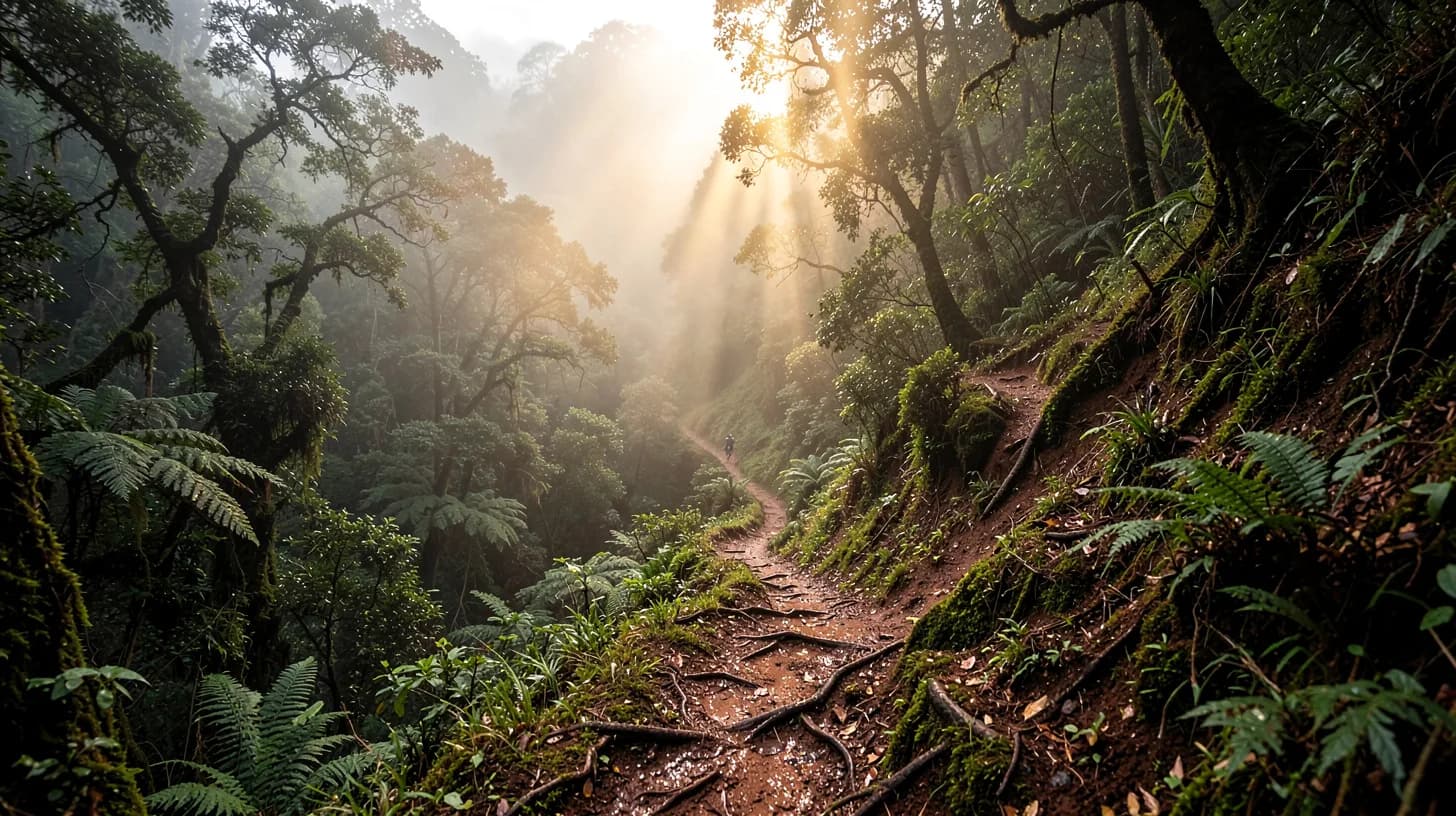
Wet Andean trails combine clay, roots, rock and leaf litter, often within a single stride.
Shoes matter more here than anywhere else: deep, widely spaced lugs shed mud instead of packing with it. Beyond the shoes, the technique is to shorten the stride, keep your weight over the supporting foot rather than behind it, and place the foot flat rather than rolling through the heel. On roots and wet rock, step on obstacles rather than beside them where possible — a root crossing the trail is often more secure than the slick channel next to it.
Trails the Oasis is being built among
Phoenix Oasis, the women-only sports and transformation retreat under construction on thirty hectares near Rivera, in Huila, Colombia, sits in exactly this kind of terrain — the hills above the Magdalena valley, where the ground rises quickly and the mornings are cool before the humidity builds.
When the retreat opens on 30 June 2028, the stays — Wake-Up Call, Reboot, Shift and Molting — are planned to include hiking and trail work as a core part of training rather than an excursion, taught progressively: climbing technique first, descending technique next, distance last. The intention is that a woman who has never run on a mountain leaves knowing how to move on one. You can follow how the training is being designed on the page for our future retreat programmes.

 Training