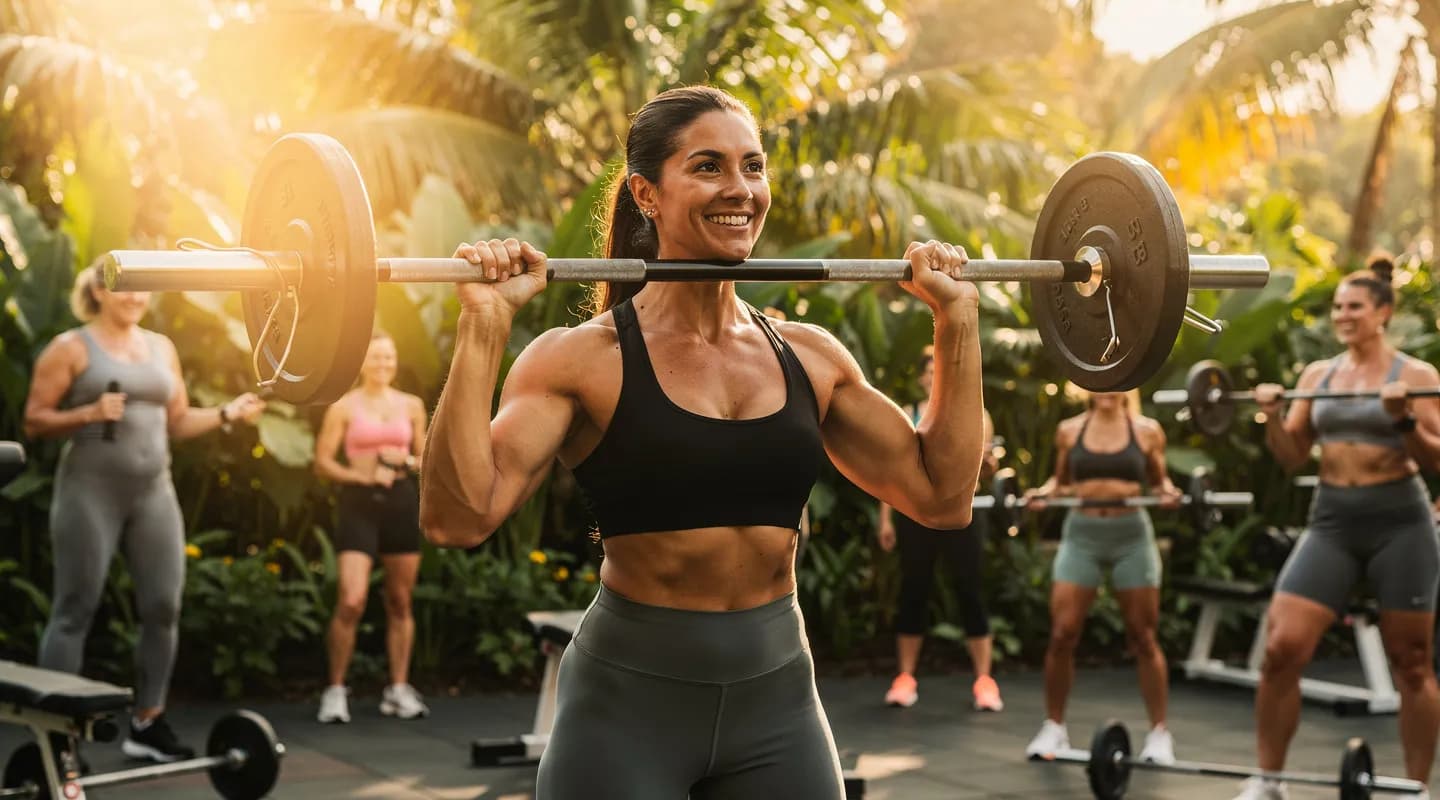
There is a version of this subject that sells very well. It comes with a four-phase infographic, colour-coded workouts, and the promise that if you lift heavy in one window and do yoga in another, your training will finally work with your body instead of against it.
There is a second version, less marketable, that goes: the research is thinner and messier than the infographics suggest, group averages hide enormous individual variation, and the most useful thing you can do is keep a simple record of your own.
This article is the second version. It is information, not instruction — nothing here is a treatment plan, and anything that concerns your health belongs in a conversation with a qualified professional who knows your history.
A short map of the cycle
A menstrual cycle is counted from the first day of bleeding. Cycle length varies widely between women and between months in the same woman; a range of roughly 21 to 35 days is commonly described as typical in adults, and variation within that range is normal.
Broadly, the first half is the follicular phase: bleeding, then a rise in oestrogen as a follicle matures. Around mid-cycle, ovulation. The second half is the luteal phase, in which progesterone rises alongside oestrogen and, if there is no pregnancy, both fall away — which triggers the next period.
Two physiological details are relevant to training and are well established. Core body temperature is slightly higher in the luteal phase, by a few tenths of a degree, which can make heat feel harder to tolerate. And progesterone has a mild effect on breathing, which some women notice as a slightly higher ventilation rate at the same effort.
What the research actually says
Here is the honest headline: when researchers pool the studies on strength, power and endurance across cycle phases, the average differences they find are small, inconsistent, and often within the noise of ordinary day-to-day variation. Systematic reviews in recent years have been notably cautious, and several have pointed out that much of the underlying research uses small samples and inconsistent methods for confirming which phase a participant was actually in.
That is not the same as saying nothing happens. It means that at the level of group averages, no phase is reliably a "strength phase" or a "rest phase" for women in general. The confident colour-coded template is a marketing artefact rather than a research finding.
What is much better supported is that symptoms matter. Cramping, heavy bleeding, disrupted sleep, migraine, gut symptoms and low mood affect training because they affect the person doing it. A day is hard because you slept badly and your abdomen hurts — not because a chart said day 24 is for restorative movement.
Why averages fail the individual
Even if a small average effect exists, it is almost useless to you personally. Variation between women is far larger than the average shift between phases. Two women in the same phase can be having entirely different weeks.
Hormonal contraception changes the picture again. Combined pills, implants, hormonal coils and injections each alter the hormonal pattern in their own way, and a large share of women of training age use one of them. A phase-based plan built on a natural cycle simply does not map onto a body on a combined pill.
And then there is everything else: sleep, work stress, travel, nutrition, illness, life. On any given Tuesday these usually explain more about how a session goes than the calendar does.
Recording instead of templating
The practical alternative is unglamorous and works. For three months, log four things next to each session: where you are in your cycle, how you slept, how hard the session felt relative to what it was, and any symptoms worth noting. A notebook is enough.
After three cycles you will have something no template can give you: your own pattern, or the discovery that you do not have a strong one. Both are useful. Women who find a consistent pattern can plan around it — placing a demanding week where their energy has historically been highest, or moving a technical session away from a day when sleep is reliably poor. Women who find no pattern are freed from a rule they never needed.
The point is that the record makes the decision, rather than a stranger's infographic.
What deserves a professional, not an article
Some things are not training questions at all, and it is worth saying so plainly.
- Bleeding heavy enough to interfere with daily life, or pain that stops you functioning, is worth a medical consultation. "Normal for women" has hidden a great many treatable conditions.
- Periods that stop or become irregular in someone training hard or eating too little are a signal to seek help, not a sign of fitness. Low energy availability has consequences for bone and hormonal health that are well documented and worth taking seriously early.
- Anyone pregnant, postpartum, perimenopausal, or managing a diagnosed condition should build their training around advice from a clinician who knows them.
None of that is pessimism. It is the difference between listening to your body and guessing about it.
A body of knowledge still being written
Women were excluded from a great deal of exercise research for decades, and the gap has not closed. Some of the most interesting work in sport science right now is finally being done on female athletes, and the picture will sharpen over the next years.
Phoenix Oasis is being built as a women-only retreat on thirty hectares near Rivera, in Huila, Colombia, opening on 30 June 2028. The programme being designed will be structured so that intensity can be adjusted rather than imposed, and so that a woman can say she needs a different day without negotiating for it. Not a phase chart on the wall — simply a structure that expects bodies to vary. You can read how the weeks are taking shape in the planned retreats.

 Training