 The Oasis
Why Rivera, Huila: How the Land for Phoenix Oasis Was Chosen
Thermal water, a climate made for training year-round, and a community worth building with: the founding intentions behind choosing Rivera, Huila, Colombia.
4 min read

The Oasis
Phoenix Initiative5 min read
There is a particular disappointment familiar to anyone who has travelled far to look at stars: you arrive, you walk outside, and there is a security light. One fixture, badly aimed, and an entire sky is gone. Not dimmed — gone, because the eye adapts to the brightest thing in view and everything fainter stops existing.
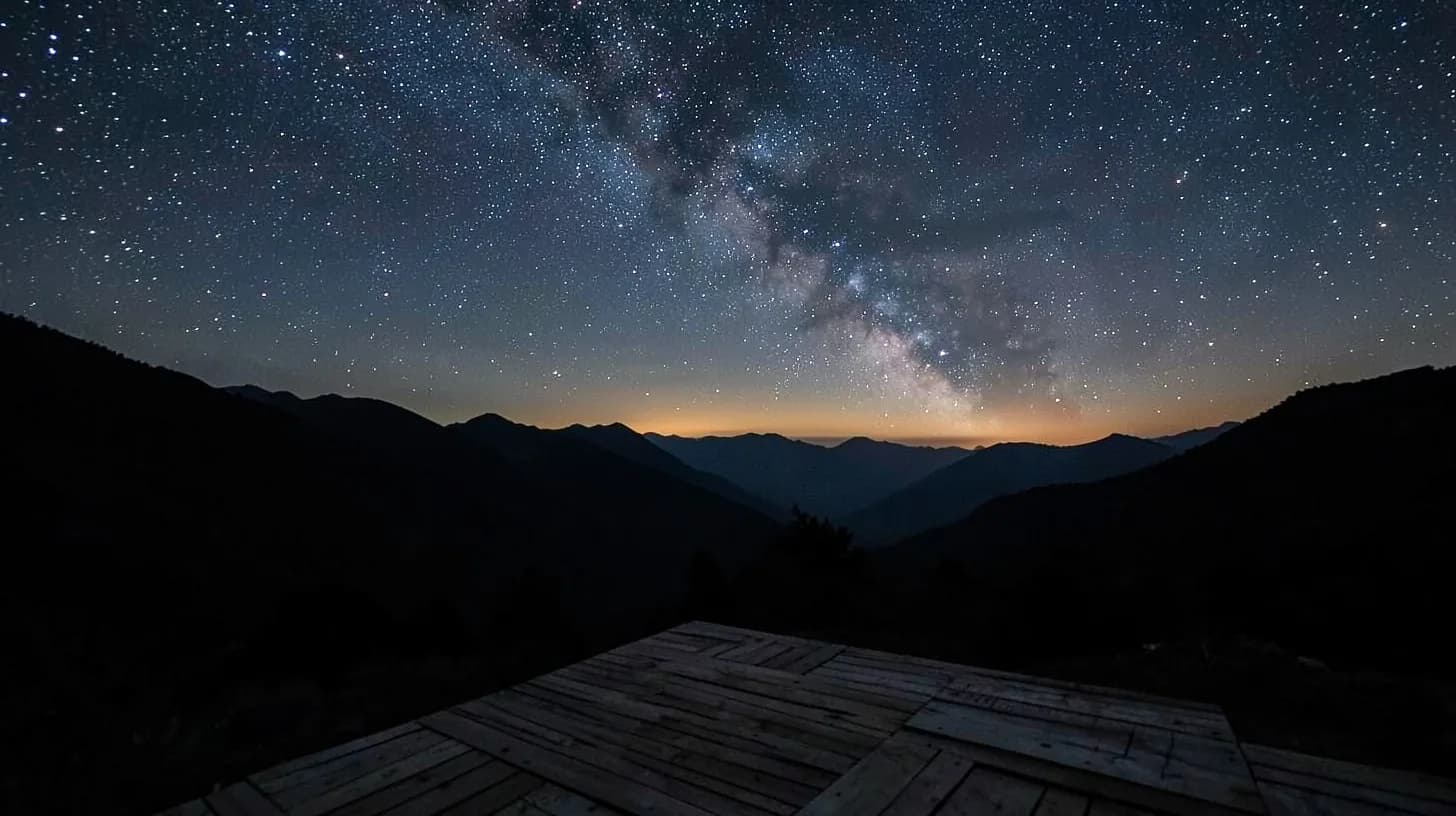
Darkness, it turns out, is an asset that has to be defended rather than a default that comes free with remoteness. It is also the one asset a valley in Huila still has in abundance, at a moment when most of humanity has lost it. Roughly a third of people alive today cannot see the Milky Way from where they live.
Phoenix Oasis will be built on thirty hectares in Rivera, and one of the pieces in the plan is a deck for looking up. Here is why the position is remarkable, and what it takes not to ruin it.
Most stargazing advice is written from somewhere around forty or fifty degrees of latitude, and it quietly assumes you will only ever see half a sky. Near the equator that assumption breaks in the best possible way.
At two or three degrees north, both celestial poles sit essentially on the horizon. Over the course of a year an observer here can see, at one time or another, almost the entire celestial sphere: the constellations a European grew up with in the north, and the southern sky she has only read about. The Southern Cross and the bright pair of Alpha and Beta Centauri climb into view in the south. Orion passes directly overhead rather than lying on its side.
Two more equatorial gifts are worth naming. Stars rise and set close to vertically here, so they spend less time in the murk near the horizon and reach useful altitude quickly. And the centre of our own galaxy, in Sagittarius, passes high overhead in tropical latitudes — the densest, most spectacular part of the Milky Way, the part that from northern Europe never really leaves the treeline.
Astronomers grade night skies on the Bortle scale, a nine-point ladder published in 2001 that runs from a truly dark site, where the Milky Way casts a visible shadow, down to an inner-city sky where a handful of stars survive.
Two things about that scale matter for anyone building in a dark place. The first is that the top of it is now rare, and getting rarer at speed. The second is that a site's rating is determined by the worst light in view, not the average — which means the difference between a class two sky and a class four sky can be a single unshielded lamp on your own land.
The colour of that lamp matters as much as its brightness. Short-wavelength blue light scatters far more strongly in the atmosphere than warm light does, which is why the modern shift to cool white LEDs made skyglow worse even where total output stayed the same.
The discipline is well established, and it is not complicated.
Applied together, these rules cost less to run than the alternative. Darkness is one of the very few luxuries that is cheaper than its opposite.
The other half of the design problem is physiological. The rod cells that do your night vision take roughly twenty to thirty minutes to reach useful sensitivity, and continue improving for a while after that. One glance at a phone screen undoes most of it in a second.
This is why serious observers use red light: it lets you see your feet while leaving the rods largely undisturbed. It is also why a stargazing deck needs somewhere to lie down. Standing and craning your neck is unsustainable after ten minutes, and the twenty minutes you spend waiting for your eyes to adjust are exactly the twenty minutes most people give up.
A last trick worth carrying: averted vision. Faint objects appear when you look slightly to one side of them, because the light-sensitive rods sit off the centre of the retina. Look straight at a faint smudge and it disappears; look just past it and it comes back.
None of this would be new to the people who lived in these mountains first. Andean sky traditions are unusual in that they name not only the bright constellations but the dark ones — the shapes formed by the dust clouds that block the light of the Milky Way, read as a llama, a fox, a toad, animals visible only because the galaxy behind them is bright enough to be interrupted. You need a properly dark sky to see any of it.
Huila has its own deep record of people watching and marking the world: the San Agustín Archaeological Park, inscribed on the UNESCO World Heritage List in 1995, sits in this same department and holds the largest group of religious monuments and megalithic sculptures in South America.
The Oasis is due to open on 30 June 2028. The stargazing deck exists as an intention on a drawing: a platform placed where the ridge blocks the least sky, far enough from anything lit, surfaced so you can lie on it, and served by the smallest amount of red light that lets people arrive without a torch.
The rest is not architecture. It is restraint — the decision, made repeatedly and forever, not to add one more lamp.
You can see what else is planned for the estate on the facilities page.
The OasisThermal water, a climate made for training year-round, and a community worth building with: the founding intentions behind choosing Rivera, Huila, Colombia.
4 min read
 The Oasis
This is a projection, not a timetable. A day-by-day sketch of how a seven-day stay is currently designed to unfold, with the caveats stated plainly up front.
5 min read
 The Oasis
Close to the equator there is no summer and no winter, but there is a calendar. Here is how the year in Huila is expected to shape training, food and the rhythm of a stay.
5 min read